Share the context
Connect the issue and relevant knowledge. Keep the decision with the work as responsibility moves between people and agents.
Jira AI and enterprise agent workflows
Run your factory across the stack you already trust.
Jira AI and Atlassian Rovo bring agents and shared knowledge into Atlassian workflows. Lit Factory connects your existing tools and coding agents on a shared Floor, with task autonomy, measurement, and automation. Keep Jira connected. Run the factory on your infrastructure.
By Lit Factory | Reviewed November 10, 2026
Choose Jira + Rovo for
Keep projects, issues, and knowledge centered in Jira and Confluence. Use Rovo and third-party agents to create, understand, and move work, backed by Teamwork Graph context and Atlassian governance.
Explore Jira AIChoose Lit Factory for
Keep the apps and coding harnesses your teams already use. Connect product, design, engineering, and business work. Guide task autonomy, share knowledge through the Brain, and optimize delivery from one place.
Explore Enterprise EditionA Jira issue needs a product decision. A developer works in Claude Code. A colleague reviews in Codex. The release depends on design feedback and a customer update in Slack. Coordinate that work on a Lit Factory Floor: a shared workspace for tasks, discussions, ownership, and decisions.
Connect the issue and relevant knowledge. Keep the decision with the work as responsibility moves between people and agents.
Choose task autonomy. Developers keep their optimized harnesses and can collaborate or intervene as the work progresses.
See where work waits. Use delivery evidence to improve routing, reviews, and follow-ups through natural-language automation.
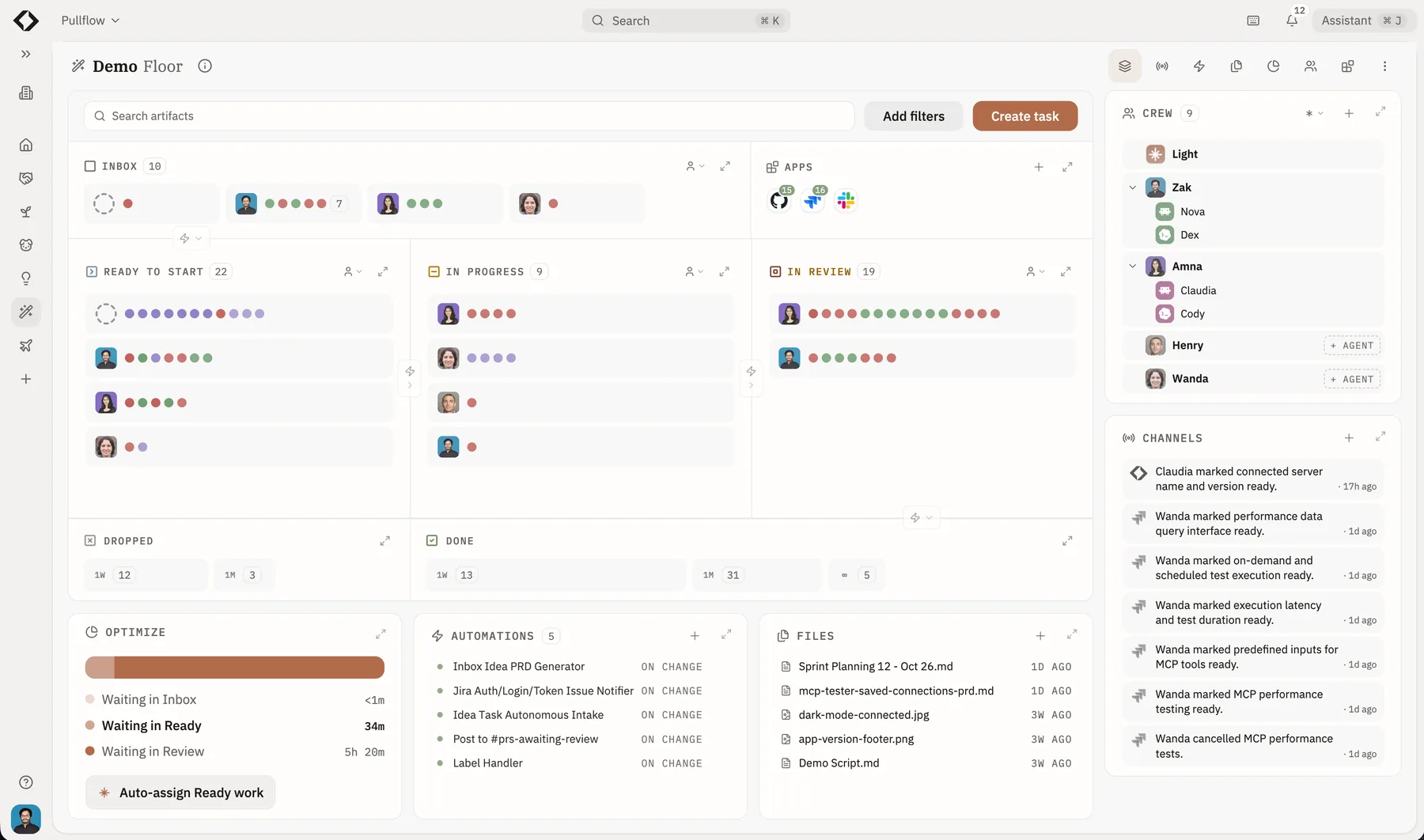
How Lit Factory works
01 / Observe
Follow work across connected tools. See progress, review queues, and handoffs on one live Floor.
02 / Orchestrate
Share decisions through the Brain. Choose task autonomy, from working together to independent execution, while developers keep their optimized harnesses.
03 / Optimize
Use delivery metrics to find repeated waits. Optimize suggests automations with a ready-to-build request you can send to Light.
Jira + Rovo
Jira organizes work items, projects, and workflows. Rovo and third-party agents can receive assignments, respond to mentions, and run through workflow transitions.
Agents in JiraLit Factory
A shared Floor connects tasks, discussions, decisions, and ownership across people, agents, and work apps. Keep Jira connected while coordinating the wider operation, or use Lit Factory's native task management.
See the lights-on workflowJira + Rovo
Jira opens work in local tools including Codex, Cursor, GitHub Copilot, VS Code, and Claude Code. It passes the work item context; optional MCP access lets the agent gather more context and update work.
Jira's local coding-tool handoffsLit Factory
Keep the harness your developers have optimized, including their skills and team instructions. Set autonomy per task to guide how the connected harness collaborates, proceeds, and seeks review. Step in as the work changes.
Choose task autonomyJira + Rovo
Rovo's Teamwork Graph connects knowledge, people, and decisions across Atlassian and third-party sources. Search, chat, and agents use that organizational context.
Atlassian RovoLit Factory
The Brain keeps organizational knowledge connected to shared work. Carry context and decisions between people and supported agents as ownership changes, so the next participant can work from the same story.
Connect knowledge to workJira + Rovo
Rovo Studio builds agents and no-code automations across Atlassian and connected apps. It includes governance, agent analytics, and testing; custom app creation is in beta.
Rovo StudioLit Factory
Describe automations in natural language. Observe throughput, delays, and contribution patterns across human and agent work. Optimize identifies recurring friction and prepares automation requests for Light to build.
Improve the whole workflowJira + Rovo
Atlassian MCP connects external AI clients to work and knowledge. Controls govern reading, writing, and deleting, with data policies and identity-provider access controls.
Atlassian MCPLit Factory
Connect supported apps, agent harnesses, and MCP tools to shared work. Bidirectional sync keeps supported work and discussions connected; configured permissions govern the actions available to each tool.
Explore connected toolsJira + Rovo
Rovo's full AI capabilities require an eligible Atlassian Cloud subscription. Data Center connectors bring Jira and Confluence knowledge into Rovo in the Cloud.
Rovo licensing and Cloud requirementsLit Factory
Run Lit Factory Enterprise on your Kubernetes infrastructure, with your database, models, and identity provider. Keep customer data private from Lit Factory and PullFlow while choosing your own model and app connections.
Explore Enterprise EditionJira AI describes AI features within Jira, including work creation, summaries, and agents. Rovo is Atlassian's broader AI offering for search, chat, agents, and Studio. Rovo Dev covers developer capabilities such as code planning, generation, and review. Atlassian is transitioning the standalone Rovo Dev product into eligible Jira subscriptions and a unified Rovo CLI; its transition FAQ has the current milestones.
Rovo Dev transition FAQYes, when you want a shared human + AI workflow across your existing stack, with task autonomy and deployment on your own infrastructure. Rovo is a strong fit when you want AI embedded in Atlassian's system of work. Both connect tools and organizational context. Compare where your team will coordinate decisions, reviews, and handoffs.
Yes. Keep Jira for issue tracking and planning, and connect its work to Lit Factory for coordination across people, coding agents, and other apps. Use the Floor to share context, assign responsibility, guide autonomy, and improve the workflow. You do not need to migrate every project to evaluate that approach.
Yes. Jira documents local coding-tool handoffs for both, with optional Atlassian MCP access for gathering context and updating work. Lit Factory also works with supported developer harnesses. Its task autonomy guides how the harness works with the team, while developers retain their configured skills and instructions.
Jira's local coding-tool handoffsCompare the full workflow cost: platform subscriptions, included usage, additional credits, model use, and infrastructure. Rovo includes pooled credits with eligible Cloud subscriptions. Lit Factory Cloud uses a shared Spark budget with unlimited humans and agents; Enterprise terms cover your own deployment. Compare the plans against the same workload.
Rovo licensing and Cloud requirementsLit Factory Enterprise runs on your own infrastructure with your database, models, and identity provider. Rovo's full AI experience requires Atlassian Cloud, including when connected to Data Center content. Choose based on where you need the platform, knowledge, and model connections to operate.
Rovo licensing and Cloud requirementsSee a Jira issue move through your existing coding agents, team decisions, and review. Explore how Lit Factory connects the workflow on your infrastructure.
Get a DemoExplore a shared ChatGPT workspace alongside organization-wide workflows on a Lit Factory Floor.
Keep your Claude workflow and connect the work to people, other coding agents, and tools across your organization.
Compare directing parallel Copilot sessions with running a shared human + AI workflow on a Lit Factory Floor.
Compare a Droid-centered platform with coordinating the coding-agent environments your teams already use.
Compare delegated engineering with coordinating your existing people, coding agents, and tools across delivery.
Compare product planning with coordinating human + AI delivery. Keep Linear connected or consolidate task management on the Floor.
Compare a coding-agent workspace with a shared Floor where people and agents move the work forward together.