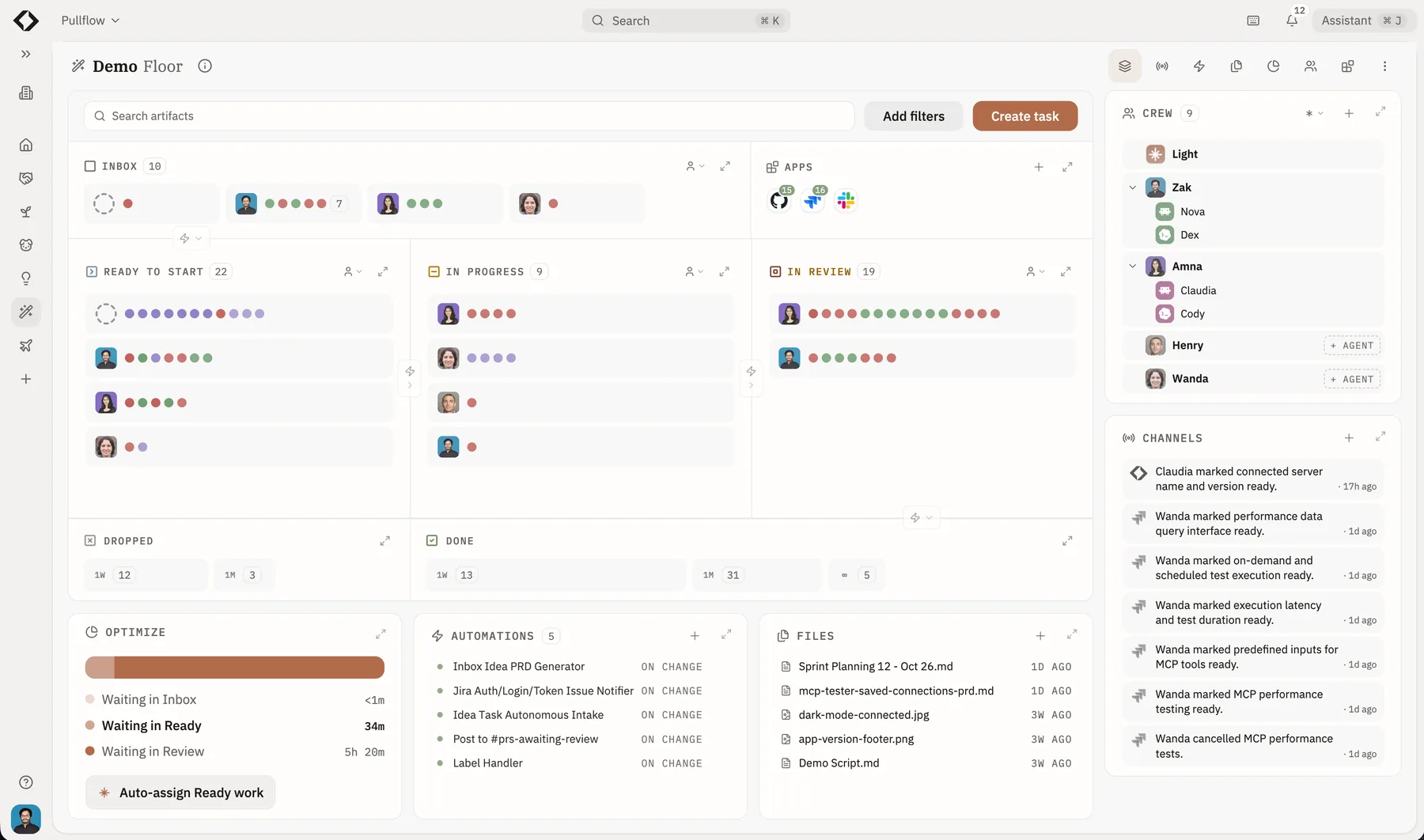
Devin brings an AI software engineer into your workflow. Lit Factory connects the people, coding agents, and tools you already use. Keep your optimized harnesses. Share context, guide task autonomy, and improve delivery across the operation.
Give Devin a migration, bug fix, or implementation task. It writes, runs, and tests code, with tools you can inspect and take over. Connect recurring work through its integrations and automations.
Keep Claude Code, Codex, and the harnesses your developers have tuned. Connect product, design, engineering, and their work. Coordinate decisions and reviews, share knowledge through the Brain, and turn repeated waits into automations.
A release spans more than implementation: a product decision, a design change, a review, a customer update. On a Lit Factory Floor, that work stays connected across people and agents. See who owns the next step and where progress needs attention.
How Lit Factory works
Coordinate people, agents, and tools from one live Floor.
01 / Observe
See what needs attention.
Follow work across connected tools. See progress, review queues, and handoffs on one live Floor.
02 / Orchestrate
Put people and agents in motion.
Share decisions through the Brain. Choose task autonomy, from working together to independent execution, while developers keep their optimized harnesses.
03 / Optimize
Remove the next bottleneck.
Use delivery metrics to find repeated waits. Optimize suggests automations with a ready-to-build request you can send to Light.
Keep the Claude Code, Codex, or other supported harness your developers have optimized. Their skills and team instructions stay part of the experience. Light is built in for shared work.
Slack, Teams, Jira, Linear, and source-control integrations bring Devin into existing workflows. Plugins and MCP servers give it tools to act across services.
People and connected agents work on a shared Floor: tasks, discussions, ownership, decisions, and review across departments and apps. Bidirectional sync keeps connected work moving.
Reusable skills support testing, deployment, and other procedures. Repository, personal, organization, and enterprise scopes let teams share instructions.
The Brain connects shared organizational knowledge to work and decisions. People and supported agents use that context as a task moves between owners, tools, and stages.
Choose autonomy for each task. It guides how the connected harness collaborates, proceeds, and seeks review. Developers keep their configured environment and can step in as the work changes.
Describe an automation in natural language. Coordinate routing, follow-ups, and connected work with Light. Use workflow evidence to decide what should be automated next.
Observe where human and agent work waits across the workflow. Measure throughput, delays, and contribution patterns. Optimize prepares automation requests to address recurring friction.
Devin centers engineering execution on Cognition's agent and its development environment. Lit Factory coordinates people, existing coding agents, and business apps on a shared Floor. Choose based on whether your priority is adopting Devin for engineering work or connecting the wider human + AI operation around the agents you already use.
Is Devin only for unattended cloud coding?
No. Devin documents local CLI work, cloud handoffs, interactive development tools, integrations, skills, and automations. Human steering and connected tools are capabilities to evaluate in both products. Lit Factory's focus is the shared operation across your team and agent mix.
Can we keep Claude Code and Codex with Lit Factory?
Yes. Connect the supported harnesses your developers already use, with their configured skills and instructions. Task autonomy guides how those agents work with the team. You can coordinate developers using different agents without standardizing everyone on one coding agent.
Can Lit Factory and Devin work together?
They can serve different roles: engineering execution and shared team coordination. Start by evaluating the tools and interfaces in your setup. This comparison does not establish a native Devin integration. Lit Factory already connects supported agent harnesses and work apps, including GitHub, Linear, and Slack.
How should we compare cost and enterprise deployment?
Compare platform fees, agent or model usage, infrastructure, and the time required to operate the workflow. Lit Factory uses a shared Spark budget with unlimited humans and agents; Enterprise runs on your infrastructure with your database, models, and identity provider. Evaluate Devin's current plan and deployment terms against the same requirements.
Run your factory with the lights on.
Bring one real delivery workflow to a demo. Follow the work across your existing agents, a shared decision, implementation, and review. See what your team can observe, orchestrate, and optimize together.